How to Find Commercial Cleaning Contracts: A Practical Plan
Learn how to find commercial cleaning contracts with referrals, direct outreach, public bids, and practical checks for scope, staffing, and price.
Commercial cleaning work rarely comes from a single source. The practical answer to how to find commercial cleaning contracts is to build repeatable channels, including referrals, direct prospecting, property manager relationships, and public bids. Qualify each opening against your crew’s capacity before spending hours on a proposal. To keep inquiries from disappearing into calls and texts, our CRM software for managing leads connects lead capture with estimates, scheduling, and follow up.
Set a clear target before prospecting: the facility types you serve, your travel radius, the crew hours you can commit, and the services you provide. A small office with routine evening cleaning has different needs from a school, medical facility, or post-construction site. When your target is specific, you can spot suitable opportunities faster and explain why your team fits.
Build your pipeline around a specific customer
Which facilities can you serve reliably with your current staff and equipment? Start with the answer, then make a list of nearby offices, property managers, retail centers, religious organizations, and other facilities that match your services. Review each prospect’s location, apparent size, operating hours, and likely cleaning frequency before you reach out.
Ask existing customers, vendors, and local business contacts for introductions to the people responsible for facility operations. A referral is most useful when it connects you to the decision maker, not simply when it provides a company name. Keep a record of who introduced you, when you contacted the prospect, and what next step you agreed on.
Use local business directories, commercial property listings, and networking groups to add prospects to your lead pipeline. Look for visible signals such as a new facility, a change in property management, or a business expanding to another location. Treat those signals as reasons to ask a question, not as proof that a contract is available.
Where can you find janitorial RFPs and public bids?

For federal work, search official procurement notices and use award records to understand which agencies buy janitorial services. The 2024 GSA assessment describes searching SAM.gov contract opportunities by keyword, solicitation ID, or agency, as well as searching award records by NAICS code and other identifiers.
Search by “janitorial services,” “custodial services,” “building cleaning,” and relevant service codes. Read each notice for the facility location, service schedule, site visit, response deadline, and submission instructions. A 2024 Congressional Research Service report explains that federal award data can be explored through SAM.gov and USAspending.gov, including filters for NAICS code, geography, agency, and contractor.
Use award history to research buyers and identify contracts that could be recompeted, but confirm each lead against the actual notice. Also check state procurement portals, city and county purchasing pages, school districts, and public universities. Set alerts when platforms allow them, and review the source on a regular schedule so a short response window does not pass unnoticed.
Can direct outreach uncover private janitorial contracts?
Yes, when your outreach is focused and relevant. Contact property managers, facility managers, and business owners with a concise introduction that names the types of sites you clean, the services you provide, and your service area. Ask how they handle cleaning now and whether they expect to review vendors. A specific, respectful question is more useful than a generic promise to provide “the best service.”
Prepare a one-page capability sheet with your service list, operating hours, contact details, and references you have permission to share. Explain how you handle routine quality checks and how customers can report an issue. If a prospect has an incumbent provider, ask whether they accept backup coverage, one-time work, or future proposals rather than pressuring them to change immediately.
Follow up once at the time you agreed, then record the outcome and next date. If the prospect has no current need, ask whether you may reconnect later. Consistent, organized direct outreach builds a pipeline without confusing a polite conversation with a sales opportunity.
Does the opportunity fit your crew and margins?
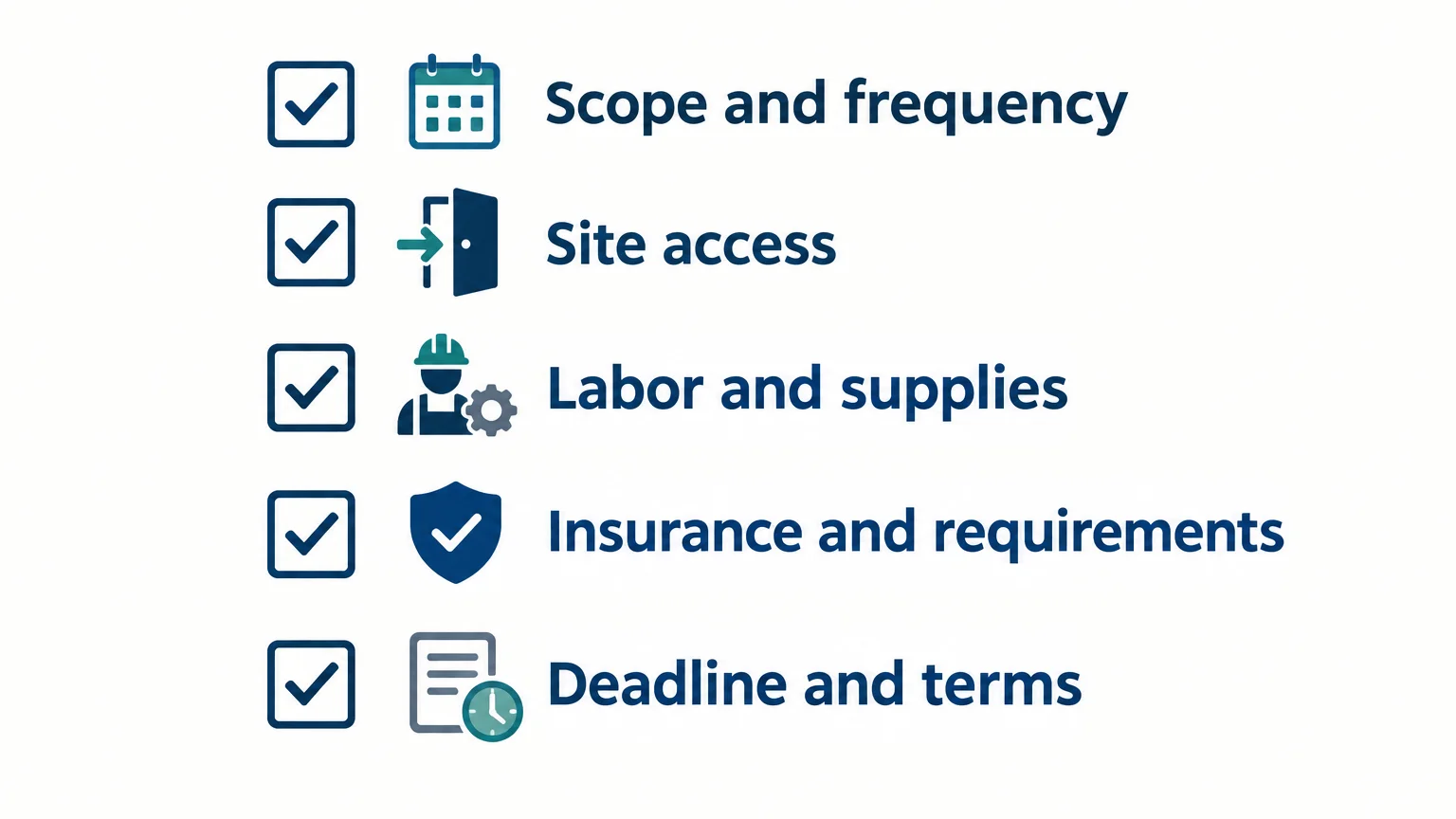
Before preparing commercial cleaning bids, compare the work required with the hours and skills your team can actually supply. Confirm the cleanable area, task list, frequency, building access, service start date, supply responsibilities, and any inspection or reporting requirements. If an essential detail is missing, request clarification before estimating.
Price the work from the expected labor, travel, supplies, equipment, supervision, and other costs your business must cover. Do not rely on square footage alone when the task list or schedule could change the workload. Our estimating software for cleaning services helps you prepare and send estimates, then track approval through a connected workflow.
A 2020 Harvard Business School working paper analyzed 1,046 competitive U.S. federal building-cleaning contracts using data from 2003 through May 2017. Its analysis considered building size and weekly cleaning frequency, illustrating why both belong in a careful scope review. That historical study is not a current price guide; use the actual site requirements and your costs to build your bid.
Before committing, check whether the contract’s timing, access rules, staffing expectations, and payment terms work for your business. A large account is not automatically a good fit if it stretches your crew too thin or leaves too little room for unexpected work. A documented bid qualification check helps you choose opportunities deliberately.
What should a strong proposal include?
Organize your response around the buyer’s instructions. Address every requested task, frequency, schedule, service area, and reporting requirement. State what is included, what is excluded, how you will handle access and supplies, and whom the buyer should contact with questions. Keep your claims specific and support them with references or relevant experience you can substantiate.
Submit the proposal in the required format and before the stated deadline. Save the final version, note any questions and answers shared with bidders, and record the decision date. If you do not win, ask whether the buyer can share feedback. Use that information to improve future janitorial contracts proposals.
Once work is awarded, make the transition clear: confirm the start date, site contact, keys or access process, schedule, and agreed scope. Our field service management software connects customer records, estimates, signed contracts, scheduling, field notes, invoicing, and payment collection, so your team can manage the job after you secure it.
Turn prospecting into a repeatable process
Finding commercial cleaning contracts takes a focused pipeline, regular prospecting, careful review of public and private opportunities, and bids grounded in the actual scope. Choose work your crew can deliver, respond exactly as requested, and track each contact through its next step. That discipline helps you spend less time chasing poor-fit leads and more time building sustainable customer relationships.
Organize Cleaning Leads and Jobs in One Workflow
Winning a contract is only the beginning; you still need to organize customer details, estimates, schedules, field records, and invoices. Our founder’s experience operating inspection and remediation businesses informs software for field-service workflows, and cleaning is one of the trade categories we support. The platform helps manage work after you find a prospect; it is not a contract marketplace.
With our software for cleaning businesses, you can capture leads, send estimates and contracts for electronic signature, schedule approved work, document jobs, and invoice customers. Each plan includes a 14-day free trial, so you can review the workflow for your business before choosing a subscription.
Frequently Asked Questions
Where should a new cleaning business look for contracts?
Start with local property managers, offices, small businesses, referrals, and public purchasing portals. Focus on nearby facilities that match your current staffing and service capacity.
How do I find janitorial RFPs?
Search SAM.gov for federal notices and check state, city, county, school district, and university procurement pages for local opportunities. Use several relevant service terms and review deadlines and eligibility instructions in each notice.
What should I check before bidding on a cleaning contract?
Confirm the task list, cleanable area, frequency, hours, access requirements, supply responsibilities, and response deadline. Estimate labor and other operating costs before deciding whether the work fits your team.
How can I get commercial cleaning clients without public bids?
Ask current customers and business contacts for introductions, then contact relevant property and facility managers directly. Keep your outreach specific and follow up when you said you would.
Can FieldCommandOS help me find cleaning contracts?
Our software is designed for cleaning and other field-service businesses to manage leads, estimates, contracts, scheduling, job records, and invoices. It supports operations after you identify a prospect, but it does not provide or secure contract leads.